DICO Standard
Classification publication DICO Documentation
| Sub area | Messages | Version Messages |
|---|---|---|
| Technical Information | SALES005 | |
| Data messages | Inleiding & Versiebeheer | SALES005 |
| Product data message | SALES005.1 | |
| Price catalogue | SALES005 | |
| Terms message | SALES005 | |
| Item relationmessage | SALES005 | |
| Transaction messages | ||
| Quotation request | SALES005 | |
| Quotation message | SALES005 | |
| Order | SALES005 | |
| Orderresponse | SALES005 | |
| Despatch advice | SALES005 | |
| Invoice | SALES005 | |
| Assetmanagement | Onderhoudsberichten | SALES005 |
| IoT Message | SALES005 | |
| CO Certification | v1.0 | |
| GIR Basisdata | v1.0 | |
| Rental | Checkout message | SALES005.1 |
| Checkout response | SALES005.1 | |
| Extensions | Overview |
The DICO standard allows companies in the construction and engineering sector to exchange information quickly, error-free and securely, regardless of the software package the company uses. It is a set of agreements that provides ground rules for the electronic exchange of information between manufacturers, wholesalers, construction, maintenance and installation companies and housing associations.
Why choose the DICO Standard:
- Exchange data without errors
- Higher data quality
- Lower costs
- Collaborate more efficiently
- Higher customer satisfaction
- Software independent
Overview DICO Standard
Currently, Ketenstandaard Bouw & Techniek supports the last two versions of the DICO Standard. Those are currently the INSBOU004 and the SALES005. Note starting with the SALES005, there will be message-level publishing/releasing.
Information structures and agreements defined in the DICO Standard are shown in the figure below. Within the DICO Standard a distinction is made between four sub-areas:
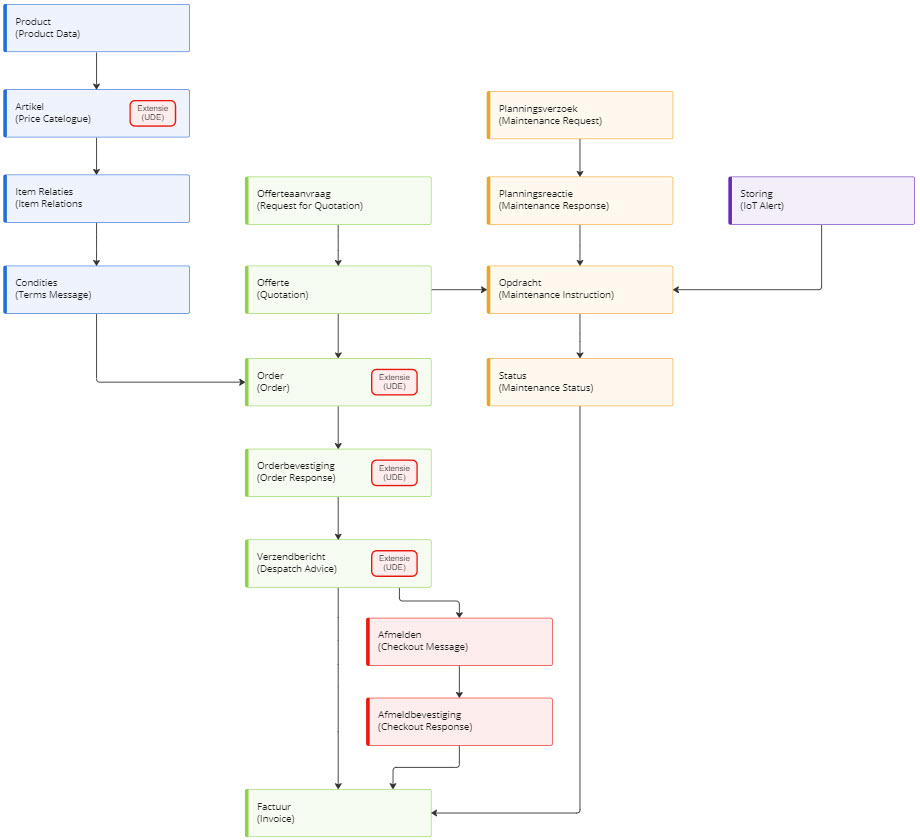
Figure 1: Ideal message flow DICO Standard, version SALES005
In the figure, User Defined Extensions (UDEs) are shown in several places. These are optional controls, additions, to existing publications. The UDE structures are in the SALES005 version.
The above classification is also reflected in the setup for the (process) documentation. The colors represent a sub-area, see table, and these in turn correspond to colors found in the DICO Management Environment, Semantic Treehouse.
| Sub area | Explanation | |
|---|---|---|
| Data messages (blue) | Processes and agreements on such things as item condition processes, product properties, packaging information and relationships can be exchanged with it. | |
| Order2pay (green) | Processes and agreements on awarding, ordering, delivery and payment, among others. | |
| Asset Management (orange & purple) | Manage and maintain processes and agreements related to assests. | |
| Rental (red) | Processes and agreements about the process of renting equipment. This can include deadlines but also how to cancel it. |
Table 1: Message flow color legend
Semantic Treehouse
The DICO Standard is managed at Semantic-Treehouse. This location contains all the technical components of the DICO Standard. Various tools are also made available in this environment. The tooling helps in proper implementation of the DICO Standard.
Available tool for participants of the DICO Standard:
- Certification
- Validation tool (with business rules)
- Endpoint (REST and SOAP)
- Units triangle
- DICO Address Registry
Exchange
It is worth noting that the exchange or transport of DICO messages is not fixed at this time. Chain Standard recommends using the Message Service 3.1 for the exchange of DICO messages. These Web services (REST and SOAP variant) were developed by questions from makrt to arrive at a single exchange format.
Technical documentation on these two web services for exchanging (whole) DICO messages can be found here:
Please note: Mircosoft is phasing out SOAP